
Written by Janice Hunt
24 September 2026
Reading time: 1,8 minutes
Write English good!
Words. They don’t (always) come easy. And when it comes to exactly where apostrophes and other punctuation marks are needed, even the most seasoned wordsmiths often struggle with self-doubt!
So here, in the spirit of knowledge-sharing, are examples of word usage, spelling and some punctuation that have tripped us up – more than once – over the years, and how to fix them.
The first issue that comes up often is using US English instead of UK/SA English. UK English is used as the standard for formal writing, spelling and grammar in South Africa, although South Africanisms do abound, mainly in vocabulary.
Here are just a few instances that may give you pause when you are writing:
- Programme is the correct use for all programmes with the exception of computer software. Program is US English for all manner of programmes.
- In UK English, a metre is a unit of measurement and a meter is a measuring instrument. US English uses meter for both.
- Practice is a noun and practise is a verb in UK English. US English uses practice for both. I double-check every time by reminding myself that ice is a noun and once I have that sorted in my head, then practise is the verb! That little trick also works for other ‘ice’ (nouns) and ‘ise’ (verbs) words.
Other common instances where US English creeps into our writing include:
US English
I already ate
Did you take a decision?
Different than
On the weekend
Monday through Friday
Write me
The person that
UK English
I've already eaten
Did you make a decision?
Different from
At the weekend
Monday to Friday
Write to me
The person who
Due to
Another example that makes the brains of many editors and writers hurt is the correct use of due to. Due to acts like an adjective and modifies a noun or noun phrase, typically following a form of the linking verb to be (is, was or were). But rather than trying to remember English grammar classes, simply try the substitution test: can ‘due to’ be replaced by ‘caused by’? For example:
- The error was caused by a system glitch. (Correct: The error was due to a system glitch)
- She failed the test caused by a lack of study. (Incorrect—here you would use ‘because of’ and not ‘due to’.)
Things that jar
We want to make it as easy as possible for our readers to get what we’re trying to tell them. Things that tend to jar the reading eye are the random use of capitals (the staff Member walked into the CEO’s Office). As far as possible, use capitals only for proper nouns and the start of sentences.
Also avoid using the ampersand in running sentences – it causes a small hiccup in the brain in those instances. She said her parents & children were at home. The ampersand is used in names such as Moët & Chandon, Procter & Gamble and so on (not & so on).
The apostrophe
And now the apostrophe. What a pretty little hanging comma it is and yet how it slinks into usage at the most inopportune moments or abandons its post when it is most needed. There are tomes dedicated to this subject, but we will keep it brief.
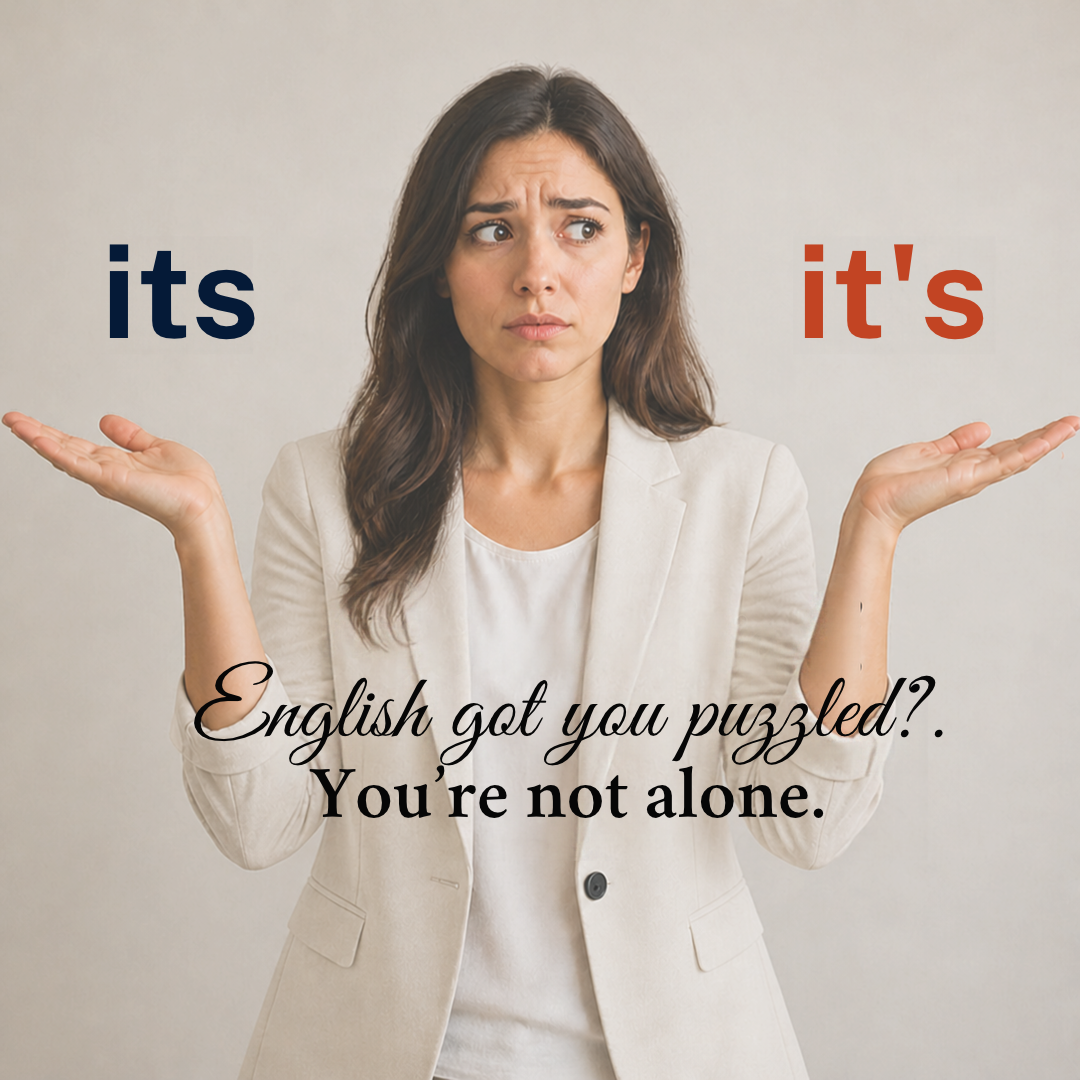
- It’s = it is: Baby, it’s cold outside!
- Its = is possessive, as in the sentence above: abandons its post.
The apostrophe is not generally used to form plurals (which is often referred to by pedants as the grocer’s apostrophe, as in Apple’s R20, Potato’s R30, Cabbage’s R10 and so on). Plurals most commonly need only an s added. Yes, there are exceptions – in English there sometimes seem to be more exceptions than rules, but don’t let that give you a headache. It’s not worth it.
For the possessive, add an apostrophe and an s: the table's legs, the dog's breakfast, the cat's pyjamas and so on. Where it could get trickier is with names and here the trick is to listen to the word. James’s car (you didn’t say James car). Don’t be put off by the s’s – it’s correct, as is Tom Robbins’s books.
Consistency x 3
A last thought: consistency is as important to writing as location is to property. You will even catch wordsmiths saying (sometimes in a rather teachery voice) ‘consistency, consistency, consistency!’ Ignore the tone by all means, but the message is worth bearing in mind.
An excellent resource
If this was interesting or of some value to you, you might enjoy an excellent and entertaining book called, Engleish, our Engleish: More common errors in South African English and how to resolve them by John Linnegar and Ken McGillivray. (www.editandtrain.co.za)
“It’s only words, and words are all I have …” with apologies to the Bee Gees!
/ENDS